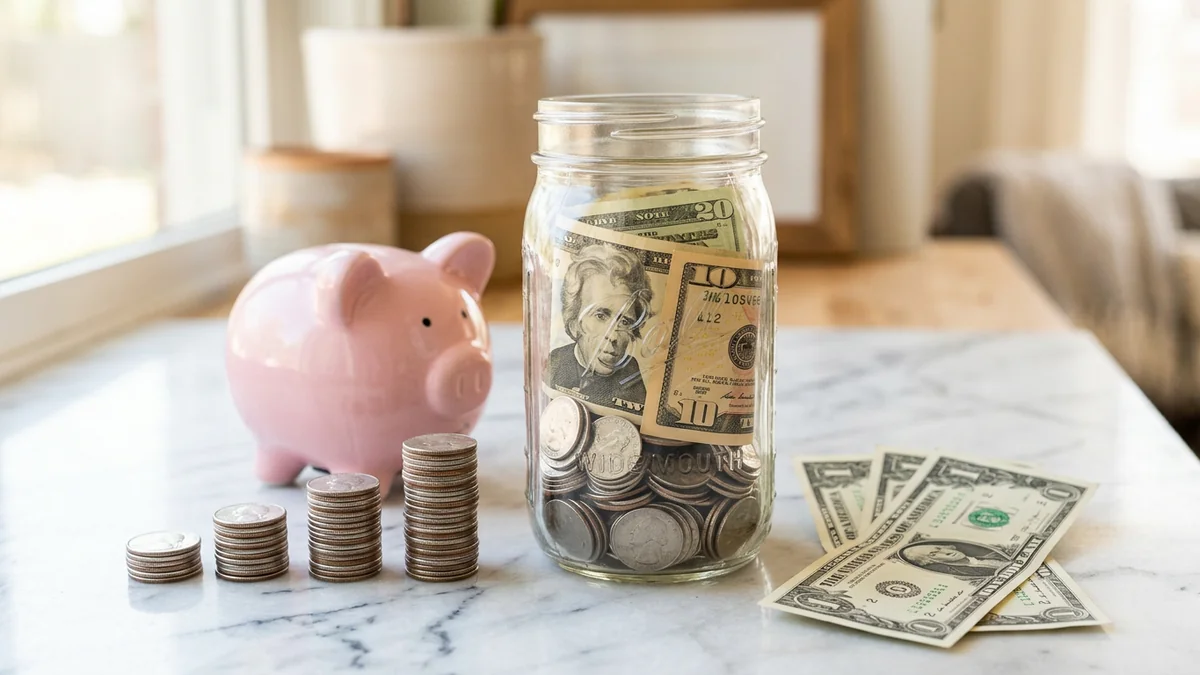
10 Ways to Save Your First $1,000
Your first $1,000 in savings is the hardest and the most important. It is hard because when you have nothing saved, every spare dollar feels like it should go somewhere else. It is important because that first $1,000 changes everything. It is a buffer against overdraft fees. It is proof that you can save. It is the seed money for every financial goal you will ever have.
If you are starting from zero, here are ten practical, proven ways to save your first $1,000 without needing to dramatically overhaul your life.
1. Run a 30-Day Subscription Audit
Open your bank statement and highlight every recurring payment. Streaming services, app subscriptions, gym memberships, magazine subscriptions, cloud storage, premium Spotify, that meal kit box you keep meaning to cancel. Most people find $30 to $100 per month in subscriptions they either forgot about or barely use. Cancel ruthlessly. You can always resubscribe later if you genuinely miss something.
2. Automate a Small Weekly Transfer
Set up a standing order to move $20 per week into a separate savings account. That is $1,040 in a year, job done. The key is making it automatic and making it happen on payday. You adjust to spending slightly less much faster than you expect.
If $20 feels too much, start with $10. That still gets you to $520 in a year, and you can increase it once you find your rhythm.
3. Use the 24-Hour Rule for Non-Essential Purchases
Before buying anything non-essential over $15, wait 24 hours. Put it in your online basket and walk away. Come back tomorrow and ask if you still want it. Research suggests that a significant percentage of impulse purchases are regretted. This simple pause eliminates most of them.
4. Sell What You Do Not Use
Walk through your home with fresh eyes. Clothes you have not worn in a year, electronics gathering dust, books you will not reread, furniture you are storing for no reason. List these on Facebook Marketplace, eBay, or Vinted. Most households have $200 to $500 worth of unused items. That is a significant chunk of your $1,000 target from things that are currently doing nothing for you.
5. Meal Plan for One Month
Food is the most flexible category in most budgets, and meal planning is the single most effective way to reduce food waste and spending. Plan your meals for the week, write a shopping list based on those meals, and stick to the list. The average household wastes hundreds of dollars per year on food that goes uneaten. Meal planning can realistically save you $50 to $150 per month.
6. Switch Your Providers
Loyalty to utility and insurance providers almost always costs you money. Spend one afternoon comparing your energy tariff, car insurance, home insurance, broadband, and mobile phone contract on comparison sites. Most people save $200 to $500 per year by switching. Some save considerably more.
7. Try a No-Spend Weekend
Pick one weekend per month and commit to spending nothing beyond genuine essentials. Cook from what you have in the cupboard, find free entertainment, walk instead of driving. A no-spend weekend saves the average person $30 to $80 per weekend. Do this once a month for a year and you have added $360 to $960 to your savings.
8. Round Up Your Purchases
Many banking apps now offer round-up features that automatically round each purchase up to the nearest dollar and move the difference into savings. If your coffee costs $3.40, $0.60 goes to savings. It sounds tiny, but across dozens of transactions per month, this typically adds up to $30 to $60 per month without any effort or sacrifice.
9. Take on a Short-Term Side Hustle
You do not need to start a business. You just need a temporary source of extra income to kickstart your savings. Dog walking, tutoring, freelance writing, selling crafts on Etsy, delivering food, or offering a skill on Fiverr. Even earning an extra $100 to $200 per month for a few months can get you to $1,000 dramatically faster. The key is directing every penny of side hustle income straight into your savings account.
10. Use a Savings Tracker to Stay Motivated
There is a reason fitness trackers work: seeing your progress keeps you going. The same principle applies to saving money. Track every deposit, watch the number grow, and celebrate milestones along the way.
A dedicated savings tracker is one of the most underrated tools in personal finance. The free Savings Calculator at Free Savings and Budget Calculator lets you enter your target, your current savings, and your monthly contribution, and it shows your projected completion date instantly. For deeper tracking with visual progress charts and milestone planning, the Budget Master Spreadsheet ($9.99) includes a built-in savings tracker alongside your full budget, giving you a complete picture of where your money goes and how quickly you are building toward your goals.
Putting It All Together
You do not need to do all ten of these things. Pick three or four that feel manageable and start this week. The combination of cutting unnecessary spending, automating small saves, and potentially adding a side income stream can get most people to $1,000 within three to six months. The important thing is to start before you feel completely ready. Waiting for the perfect moment is the most expensive financial decision you can make, because every week you delay is a week your savings could have been growing.
One approach that works well is to stack these strategies. Combine the subscription audit with automated weekly transfers and one no-spend weekend per month. That triple combination alone could deliver your $1,000 in four to five months without any dramatic lifestyle changes. Add selling unused items to the mix and you could reach your target even sooner.
That first $1,000 is a turning point. It proves to yourself that saving is possible. It creates a safety net that prevents small problems from becoming big ones. And it builds the foundation for every financial goal that comes after, whether that is building a full emergency fund, saving for a house deposit, or investing for the future.
If you are ready for a complete financial reset, not just the first $1,000 but a full 30-day transformation of your money habits, The Wealth Roadmap Workbook from Finance Scoops guides you through one action per day, 15 minutes at a time, covering budgeting, saving, debt, and investing. It is $47 at Wealth Workbook.
Start today. Your first dollar saved is the most powerful one.
🛡️ Build your safety net with the Financial Goals Planner Spreadsheet ($5.99)
or get the complete financial toolkit in the Ultimate Finance Scoops Bundle ($64), and save $20, here: The House Down Payment Savings System with Wealth Workbook
Visit financescoops.com to start with our free calculators today.