How to Set and Manage Long-Term Financial Goals
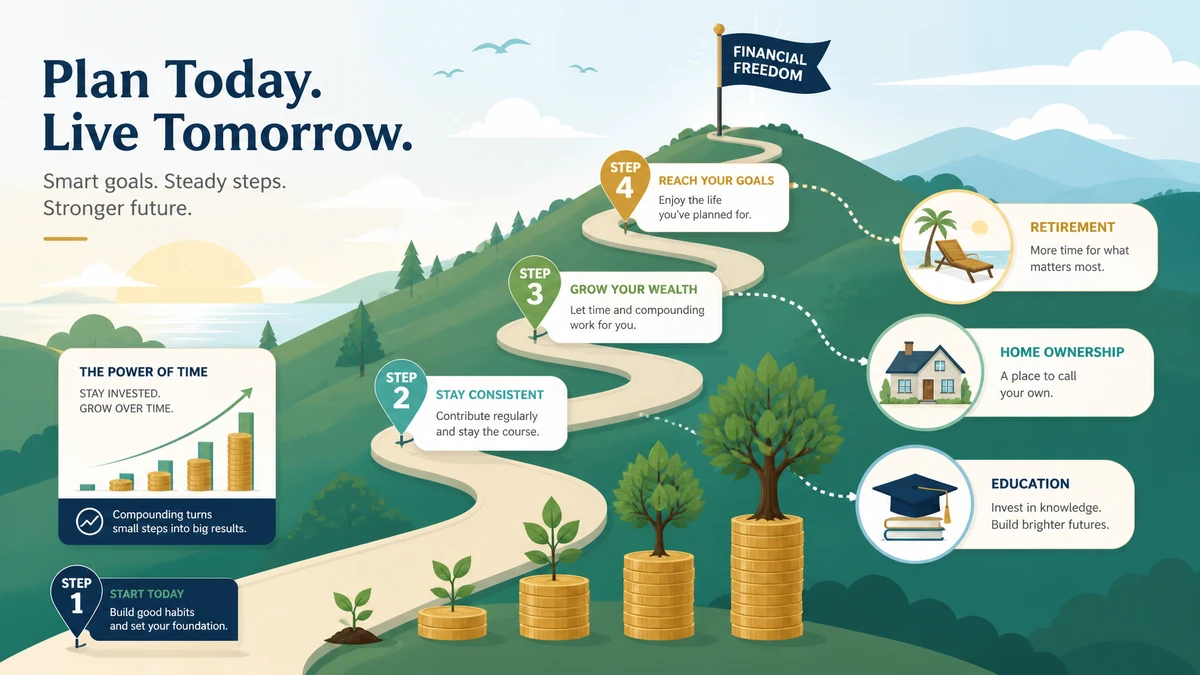
Long-term financial goals are the big, life-shaping ones: buying a home, retiring comfortably, becoming completely debt-free. They're also the goals that are easiest to lose sight of, simply because the finish line is years away. The secret isn't willpower; it's having the right system. Here's how to set and manage long-term financial goals so you keep moving forward without losing momentum.
What Are Long-Term Financial Goals?
Quick answer: A long-term financial goal is a money target that typically takes five years or more to reach, such as funding retirement, buying a home, paying off all your debt, or building a college fund.
Long-term goals differ from short-term targets mainly in their time horizon. Short-term goals (under a year or two) deliver quick wins, while long-term goals require sustained effort over many years. That longer runway is exactly what makes them so powerful for building real stability, wealth, and peace of mind.
Common examples of long-term financial goals include:
- Funding retirement so you can eventually live on your savings.
- Buying a home and building equity over time.
- Paying off all debt, including your mortgage.
- Building a college fund for your children.
Why Most People Struggle to Stick with Long-Term Goals
If you've started strong on a big goal only to drift off course, you're in good company. It happens to almost everyone, and it's rarely about a lack of discipline. The real culprits are usually structural.
The most common barriers are a lack of clarity (a fuzzy goal with no specific number or date), no system to track progress (so you can't tell if you're winning), and life disruptions (a job change, a new baby, a big move) that knock your plan sideways. Feeling stressed, overwhelmed, or inconsistent along the way is completely normal, and it doesn't mean you're failing.
The fix is to reduce friction. When your goals are written down, broken into small steps, and tracked with a simple tool, staying motivated becomes far easier because progress is visible and each action feels manageable. The right tools do a surprising amount of the emotional heavy lifting.
How to Set Long-Term Financial Goals That Actually Work
A great long-term goal is specific, measurable, and broken into pieces you can act on this month. Here's how to build one.
Use the SMART Framework for Financial Goal-Setting
SMART stands for Specific, Measurable, Achievable, Relevant, and Time-bound. In a personal finance context, that means naming exactly what you want, attaching a dollar figure, making sure it's realistic, confirming it matters to you, and setting a target date. "Save for retirement" becomes "build a $600,000 retirement fund by age 60," which is something you can actually plan around.
Break Big Goals into Yearly and Monthly Milestones
A ten-year goal feels overwhelming until you reverse-engineer it. Suppose you want to save $120,000 over ten years. That's $12,000 a year, or $1,000 a month, a number you can budget for. Here's a simple example of how that breaks down:
| Timeframe | Target Contribution | Cumulative Progress |
|---|---|---|
| Monthly | $1,000 | Steady, budgetable habit |
| Year 1 | $12,000 | 10% of the way there |
| Year 5 | $60,000 | Halfway milestone |
| Year 10 | $120,000 | Goal reached (before growth) |
And that's before investment growth, which can carry you across the finish line even faster. Building a yearly review habit keeps these milestones on track; our annual financial planning checklist is a great way to check in once a year.
Align Your Goals with Your Current Budget
A goal only works if your budget can support it. Before committing to a monthly target, look at your income and expenses to see what's realistic. If the gap is too big, you may need to trim spending, boost income, or extend your timeline. Our guide on how to create a monthly budget that works helps you find exactly how much you can put toward your goals each month.
The Best Tools to Track Long-Term Financial Goals
Long-term goals live or die by tracking. These three tools make the years-long journey feel manageable and even motivating.
Why a Financial Goals Planner Changes Everything
A structured planner beats loose notes or mental tracking every time. It keeps every goal, deadline, and milestone in one place, so you always know where you stand. Many Finance Scoops users find that simply seeing their goals written down and organized makes them dramatically more likely to follow through. A dedicated financial goals planner gives you that structure from day one.
How Net Worth Tracking Reveals Real Progress
Watching your net worth climb is one of the most satisfying ways to validate years of effort. Even when a single goal feels slow, your overall net worth tells the bigger story of steady progress. A simple net worth tracker spreadsheet lets you see that upward trend and stay motivated through the long middle stretch.
Using Retirement Calculators to Stay on Course
Retirement-specific tools show whether your current habits align with your future goals. A quick check-in tells you if you're saving enough or need to adjust. Our free retirement calculator helps you see whether you're on pace for the retirement you want, decades before you get there.
How to Stay Motivated Over the Long Haul
Motivation naturally ebbs over a multi-year goal, so the key is to build systems that don't depend on it. A few habits make all the difference:
- Automate your contributions so progress happens whether you feel motivated or not.
- Celebrate small wins at each milestone to keep the journey rewarding.
- Review your goals quarterly to stay connected to your bigger why.
Remember that life changes, like a job loss, a new baby, or a salary increase, call for adjusting your goals, not abandoning them. If your circumstances shift, our guide on how to rebalance your household budget after a change helps you recalibrate and keep moving forward.
Common Long-Term Financial Goal Mistakes to Avoid
Steer clear of these frequent missteps, and treat each one as a learning opportunity rather than a failure:
- Setting goals without timelines, which leaves you with no way to measure progress or urgency.
- Ignoring inflation, which quietly erodes your buying power over the years, so aim a little higher than today's costs.
- Not automating savings, which leaves your progress at the mercy of willpower and memory.
- Skipping regular reviews, so a plan that no longer fits your life quietly drifts off course.
Long-Term Financial Goals by Life Stage
Your priorities naturally shift as you move through life, even though the core principles stay the same. Here's what to focus on at each stage.
Goals in Your 20s and 30s: Build the Foundation
This is the time to build an emergency fund, tackle student debt, and start investing early so compound growth has decades to work. A widely cited benchmark is to save around 15% of your income for retirement, and starting young makes that far easier to hit. Even small contributions now can outgrow much larger ones made later.
Goals in Your 40s and 50s: Accelerate and Protect
In your peak-earning years, focus on maximizing retirement contributions, paying down your mortgage, and building additional income streams. Diversifying how you earn adds resilience and speeds up your progress; our guide to passive income ideas that fit your budget offers realistic ways to start.
Goals Nearing Retirement: Shift to Preservation
As retirement approaches, the emphasis moves from growth to protection: safeguarding your assets, planning your withdrawals, and creating stable income. Our guide to retirement income planning walks through how to turn a lifetime of savings into a dependable paycheck.
Frequently Asked Questions
What is considered a long-term financial goal?
A long-term financial goal is one that typically takes five years or more to achieve. Classic examples include saving for retirement, buying a home, paying off all your debt, or funding a child's college education. The defining feature is the extended time horizon, which requires sustained, consistent effort rather than a quick sprint. Because they're so far out, these goals benefit most from automation and regular tracking.
How many long-term financial goals should I have at once?
Two or three long-term goals is manageable for most people, especially when one of them, like retirement, is a lifelong priority. Focusing on a few lets you commit meaningful resources to each rather than spreading yourself thin. You can absolutely pursue short-term goals alongside them, but keeping your major long-term goals to a small, clear list makes them far easier to stay committed to.
How do I stay motivated when my financial goals feel far away?
Break the big goal into smaller yearly and monthly milestones so you always have a near-term target to celebrate. Automating your contributions removes the need for constant willpower, and tracking your net worth lets you see steady progress even when the final goal is years off. Reviewing your goals every quarter also reconnects you with your reasons for pursuing them, which keeps motivation alive.
What tools can help me track long-term financial goals?
A dedicated financial goals planner keeps all your goals, deadlines, and milestones organized in one place. A net worth tracker shows your overall progress over time, and a retirement calculator tells you whether your current savings habits are on pace for the future. Used together, these tools turn a vague, distant goal into a clear, measurable journey you can actually manage.
How often should I review and update my long-term financial goals?
A quarterly check-in works well for most people, with a more thorough review once a year. Regular reviews let you adjust for changes in income, expenses, or life circumstances before they knock you off course. An annual financial planning checklist makes this easy. The goal is to treat your plan as a living document that evolves with you, not a one-time decision you set and forget.
Can I pursue long-term goals while still paying off debt?
Yes, and many people do both at once. A common approach is to knock out high-interest debt first while still contributing enough to capture any employer retirement match, since that match is essentially free money. Once high-interest debt is gone, you can redirect those payments toward your long-term goals. Balancing debt payoff with steady investing lets you make progress on multiple fronts.
What is the difference between a long-term financial goal and a retirement plan?
A retirement plan is one specific type of long-term financial goal, focused solely on funding your life after you stop working. Long-term financial goals are broader and can include buying a home, paying off your mortgage, or building a college fund in addition to retirement. Think of retirement planning as one important chapter within your overall long-term financial strategy.
The Bottom Line
Long-term financial goals succeed when you make them specific, break them into monthly milestones, automate your progress, and track it with the right tools. Adjust when life changes, celebrate the small wins, and remember that consistency beats intensity every time. Ready to map out your future? Start with our financial goals planner and check your pace with the free retirement calculator today.